
Why We Crave Comfort Scents : The Psychology of Scent and Memory
A single inhale can collapse the distance between now and then — returning you to a grandmother’s kitchen, a first love’s jacket, or a childhood bedroom in one suspended moment. This is the extraordinary power of comfort scents, and science is only beginning to explain it.
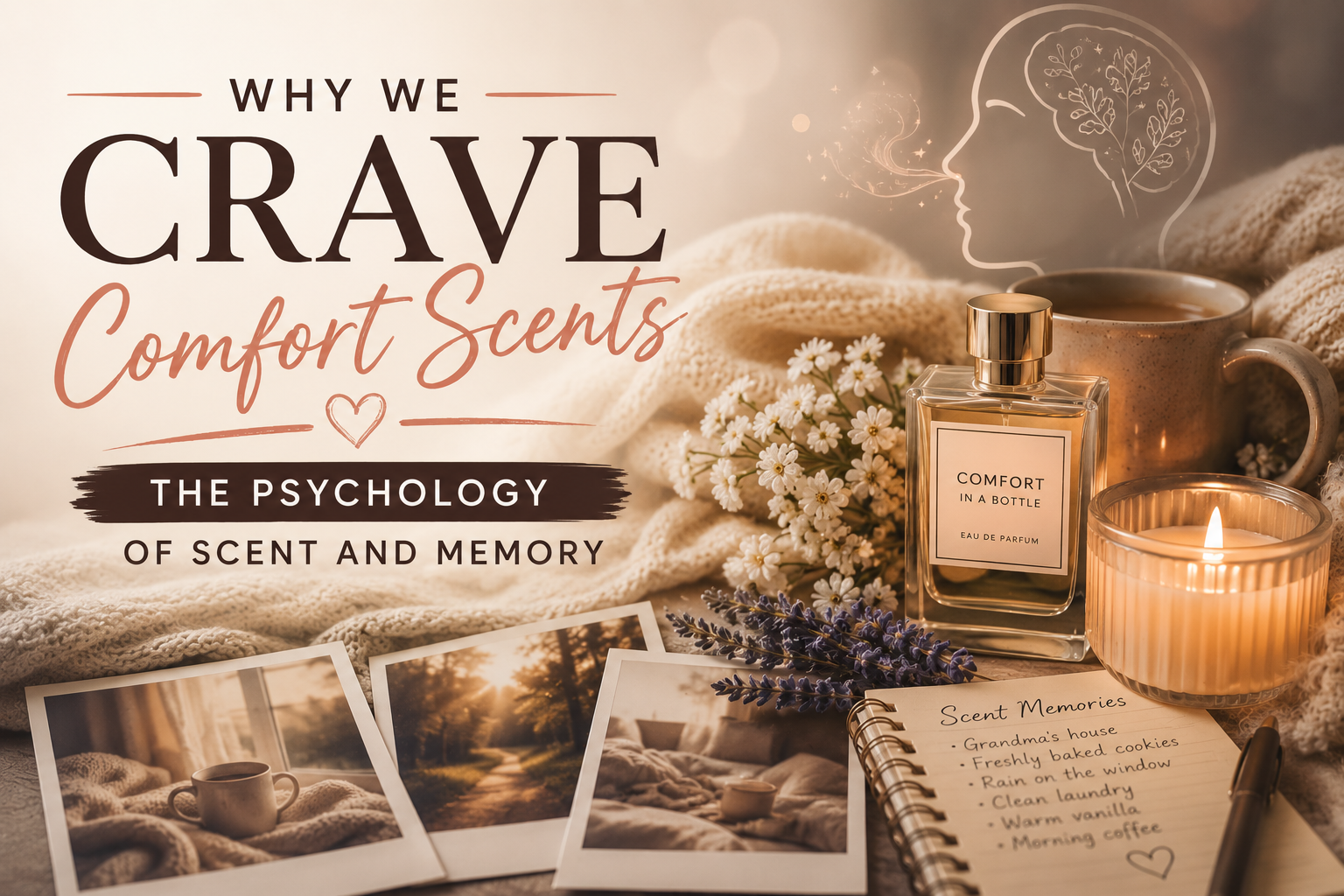
There are fragrances we wear to impress, and then there are the ones we reach for at the end of a hard day — the bottle on the nightstand, the worn travel-size tucked into a weekend bag, the scent we have repurchased seventeen times without once questioning why. These are our comfort scents : the olfactory equivalent of a weighted blanket, a mug of tea, a voice on the phone that knows us completely.
Understanding why we crave comfort scents — and how to identify and cultivate them intentionally — has become one of the most compelling conversations in contemporary fragrance. As mental health awareness has entered the mainstream and self-care has evolved from buzzword to genuine wellness practice, the emotional dimension of perfume has moved from peripheral to central. Fragrance houses have taken notice. Niche perfumers are explicitly designing for emotional well-being. And consumers are, more than ever, choosing scent as a tool for mood regulation, grounding, and memory preservation.
But what is actually happening when a scent soothes us? Why do certain fragrances feel like home while others, however technically beautiful, leave us cold? This article unpacks the neuroscience, the psychology, and the deeply personal calculus of comfort scents — and offers a practical framework for finding yours.
The Science Behind Why Scents Trigger Emotions
Of all five senses, smell is the only one with a direct anatomical line to the brain’s emotional core. When you encounter a fragrance molecule, it binds to receptors in the nasal epithelium, which transmit signals immediately to the olfactory bulb. From there — and this is the crucial distinction — signals travel directly to the amygdala (the brain’s emotional processing hub) and the hippocampus (our primary memory archive), without first passing through the thalamus as every other sensory signal does.
This architectural shortcut is why smell bypasses rational filtering more completely than sight or sound. You don’t think about a scent memory — you are transported by it. The emotional response arrives before conscious interpretation, which is why the experience of encountering a comfort scent often feels more like a physical event than a thought.
“The olfactory system is the only sense that connects directly to the limbic system without a relay station. Scent hits emotion first, analysis second — and that sequence matters enormously for why certain fragrances feel so personally significant.”
Research in olfactory neuroscience has consistently demonstrated what perfumers have known intuitively for centuries: scent memories are uniquely vivid, unusually emotional, and remarkably durable. A 2014 study published in Chemosensory Perception found that odour-evoked memories were rated as more emotionally intense than memories triggered by music, photographs, or verbal cues — even when the underlying event was identical. The Proustian phenomenon — that sudden, involuntary, overwhelmingly vivid recall triggered by a scent — is neurologically real and neurologically distinct from other forms of memory.
Why Comfort Scents Form During Formative Years
The period of olfactory memory formation that has the greatest long-term emotional weight is childhood. Between birth and approximately age five, the brain is creating its primary scent-emotion associations: the smell of a parent’s skin, the detergent on clean pyjamas, the specific air of a childhood home. These associations are encoded deeply because they are formed alongside the emotional templates of safety, love, and belonging — the neural bedrock of comfort itself.
This is why so many comfort fragrances cluster around warm, enveloping notes: vanilla, musk, tonka bean, sandalwood, benzoin, and soft ambers. These ingredients mimic the olfactory signature of warmth and physical closeness — qualities that the limbic system learned to associate with safety during those early years. When we encounter them as adults, we are not merely smelling something pleasant. We are, neurologically speaking, returning briefly to the felt sense of being cared for.
For a deeper look at how fragrance families map to emotional responses, see our guide to understanding fragrance families and what they say about you — a useful companion to this piece.
The Psychology of Comfort Scents : Emotional Anchors, Nostalgia, and Identity
Beyond neuroscience, comfort scents operate through a set of well-documented psychological mechanisms that explain both their power and their profound individuality.
Emotional Anchoring
In behavioural psychology, an anchor is a stimulus that reliably triggers a specific emotional or physiological state. Comfort scents function as extraordinarily potent emotional anchors — often because we have worn them during repeated experiences of safety, pleasure, or connection. A fragrance worn consistently during periods of creative flow, romantic love, or restful vacation days becomes neurologically associated with those states. Encountering it again activates the entire emotional package.
This is why many people find that their comfort scent is not necessarily the most complex or technically impressive fragrance they own. It’s the one with the densest emotional history — the one that has been a witness to the moments that matter.
Nostalgia and the Comfort of Memory
Nostalgia — the bittersweet pull toward the past — has been extensively rehabilitated by psychological research in recent decades. Far from being a passive or melancholic state, nostalgia has been shown to enhance social connectedness, reinforce personal identity, and measurably improve mood. Comfort scents are one of the most reliable personal nostalgia triggers available, which partly explains the therapeutic value many people report from using a beloved fragrance intentionally during stress.
The growing body of research on fragrance and emotional well-being has influenced not just individual consumers but entire segments of the fragrance industry. Wellness fragrance — designed explicitly for emotional regulation rather than social presentation — is one of the fastest-growing categories in the luxury market, a trend we’ve tracked closely in our feature on how wellness is reshaping niche perfumery.
Scent and Personal Identity
Comfort scents are also identity objects: material extensions of the self that communicate who we are — to ourselves as much as to others. Wearing a fragrance consistently transforms it into a signature, a kind of olfactory autobiography. The comfort derived from a signature scent is partly the comfort of self-recognition: of arriving home to yourself.
In a world that frequently demands we perform different versions of ourselves across different contexts, there is something quietly powerful about a scent that remains constant — that smells the same on Monday morning and Saturday evening, in triumph and in exhaustion. This constancy is itself comforting, and it’s a quality that the most beloved comfort fragrances reliably deliver.
The Science in Brief
Direct limbic access: Olfactory signals reach the amygdala and hippocampus before conscious processing begins.
Emotional encoding: Scent memories are more emotionally intense and durable than memories from other senses.
Formative associations: The strongest comfort-scent bonds are often formed in childhood and reinforced through repeated positive experience.
Therapeutic nostalgia: Intentional use of comfort scents can measurably improve mood and reinforce a sense of personal continuity.
How Fragrance Affects Mood: The Comfort Chemistry
Beyond personal memory, certain fragrance ingredients have measurable psychophysiological effects — a finding that has driven the mainstreaming of aromatherapy and, more recently, influenced niche perfumers working in the emotional wellness space.
Lavender’s anxiolytic (anxiety-reducing) properties are among the most replicated findings in olfactory science. Bergamot has been studied for its mood-lifting effects, with several trials finding measurable reductions in anxiety and fatigue following inhalation. Sandalwood, a fixture of comfort-oriented fragrances, has demonstrated sedative properties in multiple studies. Rose and jasmine compounds have shown anxiolytic effects in animal and human models. Vanilla, beloved in gourmand and oriental fragrances, has been associated with reduced stress responses and increased feelings of calm.
These are not folk claims. They are the findings of a maturing scientific literature that is beginning to validate what traditional perfumery, Ayurvedic practice, and Chinese medicine have known for millennia: certain scents act on the nervous system in ways that extend well beyond the merely aesthetic.
The practical implication for comfort fragrance is significant. A well-chosen scent does double duty — operating simultaneously on the psychological level (via personal memory and emotional association) and the physiological level (via direct neurochemical pathways). This is why the best comfort fragrances often feel qualitatively different from other perfumes: they are doing more work, on more levels, than a fragrance worn purely for its beauty or social function.
How to Find Your Comfort Scent: A Practical Guide
Identifying your comfort scent is less about finding a technically superior fragrance and more about understanding your own olfactory autobiography. Here is a framework that works for both fragrance newcomers and experienced collectors alike.
Comfort Fragrance Recommendations for Women
The following fragrances have been selected for their ability to deliver genuine emotional comfort — not merely technical beauty. Each occupies a different position on the comfort spectrum, from softly enveloping to confidently warm.
For Calm and Emotional Safety
When the goal is a scent that reduces rather than stimulates — that creates a buffer between you and the world — reach for the warmest, most enveloping compositions in the oriental and soft woody families.
Chanel No. 5 is worth singling out: it is perhaps the most studied comfort scent in existence, and its staying power across a century of fashion is partly explained by its psychological profile. The aldehydic-floral structure creates an airy, almost dreamlike opening that settles into a soft, warm base — a trajectory that mirrors the felt experience of relaxation itself. Our full review at Dry Down Diaries explores why Chanel No. 5 still deserves its iconic status.
For Nostalgia and Romantic Warmth
Fragrances in this category tend to feel like memory made material — rich, slightly sweet, deeply human, with a presence that lingers warmly on skin rather than demanding attention.
Parfums de Marly Delina has acquired a devoted following precisely because it delivers comfort without softness of character — it is expansive and confident, yet the rose and musk combination has a warmth that reads as deeply personal. It is the kind of fragrance that feels as though it was made specifically for you.
For Confidence and Emotional Presence
Comfort does not always mean quiet. Some of the most emotionally sustaining fragrances are those that make you feel most fully yourself — which, for many people, means something with real presence and character.
For those drawn to darker, spicier comfort — and the particular feeling of being fully inhabited by a scent — don’t overlook Dior Poison Fresh, which delivers an addictive, almost narcotic comfort in its Poison lineage, softened for contemporary sensibility.
Comfort Fragrance Recommendations for Men
The concept of the comfort scent has historically been less explicitly marketed to men, but the underlying psychology is identical. Men’s comfort fragrances tend to cluster in the warm woody, oriental, and fresh aquatic families — though the growing emotional intelligence around fragrance is expanding that conversation considerably.
For Warmth and Emotional Grounding
Tom Ford Tobacco Vanille deserves particular attention in any discussion of comfort scents. It is one of the rare fragrances that functions almost universally as a comfort trigger — across genders, across cultures, across personal histories — because its combination of warm tobacco, sweet vanilla, and rich woods maps so directly to the neurological signature of warmth and safety. It is, simply put, olfactory architecture designed for comfort.
For Confidence and Presence
Hidden Comfort: The Lattafa Discoveries
For those willing to explore beyond the established luxury houses, the Middle Eastern perfume tradition — particularly the Arabic ouds and warm amber compositions — offers some of the most genuinely comforting fragrances available at any price point. Lattafa Khamrah Qahwa is a revelatory comfort scent: warm coffee and amber over a sweet-spiced base that is simultaneously exotic and deeply familiar. Lattafa Qaed Al Fursan Untamed and Lattafa Eclaire round out a trio that delivers the warm, enveloping comfort of much more expensive fragrances.
Our comprehensive overview of Lattafa’s best fragrances and why they punch above their price covers this in detail for anyone curious about the full range.
Using Comfort Scents Intentionally: A Practice, Not Just a Preference
The most sophisticated approach to comfort fragrance is not simply to own one, but to use it with intention — to actively cultivate the conditions under which a scent becomes a comfort anchor rather than merely a pleasant smell.
Fragrance therapists and wellness-oriented perfumers increasingly recommend what might be called a scent practice: the deliberate, consistent application of a chosen fragrance during experiences of intentional rest, pleasure, or restorative activity. The logic is straightforward: the more you pair a scent with positive emotional states, the more effectively it will become an anchor for those states when you need to access them deliberately.
This is not magic, and it is not merely marketing from wellness-inflected brands. It is the same conditioning principle that underlies every emotional anchor — applied with intention to one of the most potent sensory channels available to us.
Consider: wear your chosen comfort scent on your most restful days. Apply it before meditation, before sleep, before creative work you love. Limit its use initially to contexts that are already emotionally positive. Over weeks and months, the fragrance will absorb those associations — becoming, in a very real sense, the smell of your own wellbeing.
A comfort scent is not found — it is made. It accumulates meaning through repeated use during the moments that matter, until it becomes a portable repository of your own peace.
Ready to Find Your Comfort Scent?
Explore our full fragrance reviews and discovery guides at Dry Down Diaries — where niche fragrance meets real emotional intelligence.
Browse Fragrance ReviewsThe Scent of Home: A Final Thought
We crave comfort scents for the same reason we return to beloved books, familiar music, and the houses we grew up in: because the brain keeps a record not just of events but of the felt quality of our best experiences, and because certain stimuli — particularly scent — can return us to those experiences more completely than any other sensory channel.
In a cultural moment characterized by fragmentation, acceleration, and chronic ambient stress, the comfort scent is a modest but genuinely powerful technology of self-care. It costs nothing beyond the fragrance itself, requires no special knowledge or practice to begin, and delivers its benefits with remarkable reliability once the anchor is established.
The science of scent and memory is still young, but its central finding is already clear: smell is the sense of emotional time travel. Used deliberately, a comfort fragrance is a way of carrying your most settled, most present, most at-peace self with you wherever you go.
That seems worth the effort of finding.