
How to Properly Store Your Perfume Collection to Prevent Spoilage
Heat, light, and air are your fragrance’s worst enemies. Here’s the expert guide to keeping every bottle in your collection performing at its best — for years.
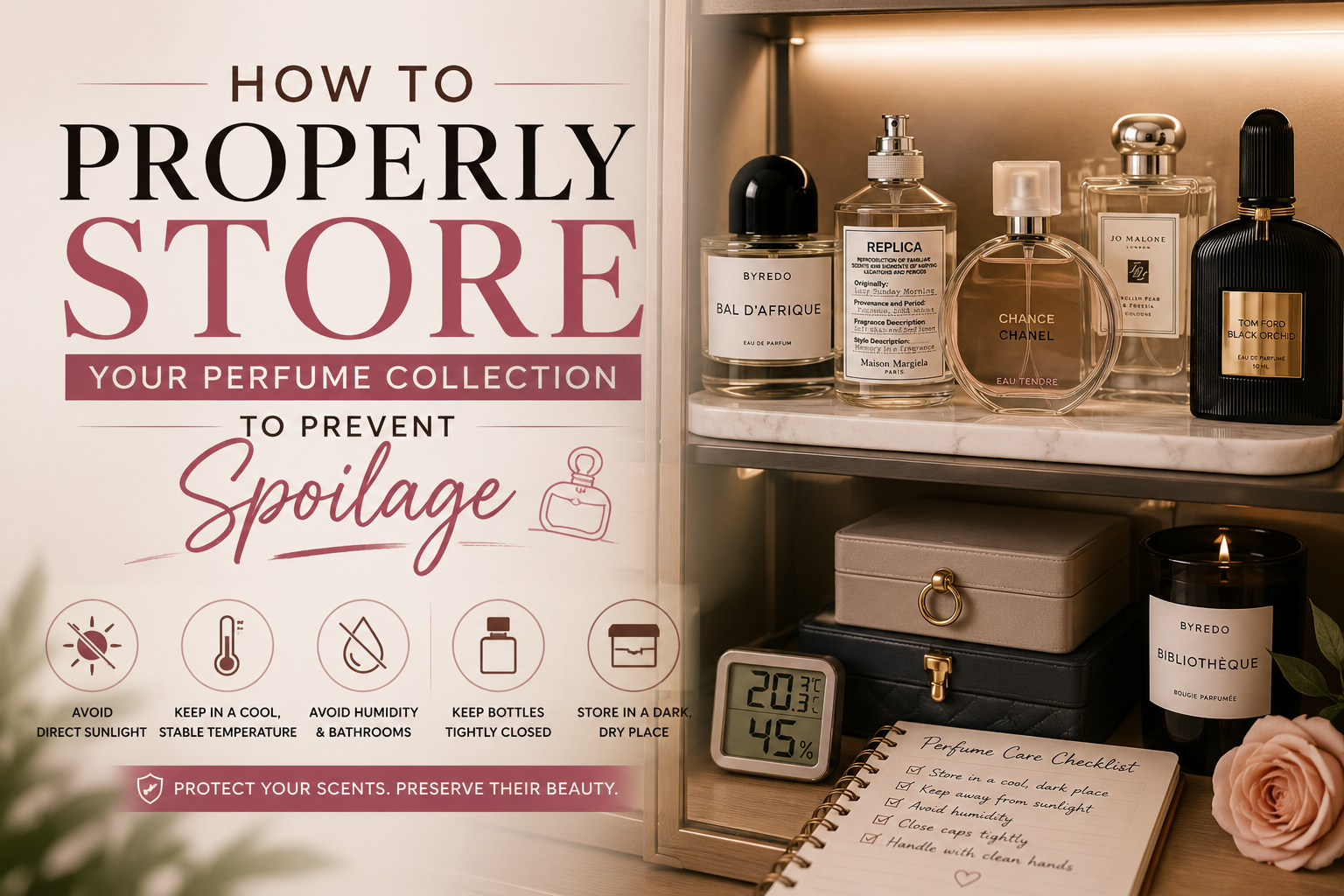
You’ve spent real money on your fragrance collection. A £120 designer EDP. A £200 niche bottle you hunted down for months. A couple of thoughtfully chosen gifts you want to last. And then you leave them on the bathroom windowsill — the single worst place a fragrance can live.
Improper perfume storage is the most preventable cause of fragrance spoilage, and it’s far more common than most people realise. Within months, heat and UV light can fundamentally alter a fragrance’s scent profile — sharpening its edges, flattening its depth, or producing sour, vinegar-like top notes that have nothing to do with how it smelled when you bought it.
This guide covers everything you need to know about how to store perfume properly — from the science of what causes degradation to practical storage solutions for every budget. Whether you have two bottles or two hundred, the principles are the same, and getting them right costs almost nothing. As DryDown Dairies’ complete fragrance preservation guide establishes, proper storage is the single most impactful thing you can do to protect your collection’s longevity.
“A fragrance stored correctly can last 3–5 years beyond its nominal shelf life. The same fragrance stored badly might be unrecognisable within a year.”
Why Perfume Storage Matters More Than You Think
Fragrance is a perishable product. It’s easy to forget this when you’re looking at a beautifully engineered bottle — but inside that glass is a complex cocktail of aromatic molecules, alcohol, and essential oils that are actively sensitive to their environment.
The cost of getting storage wrong is real. A premium fragrance that degrades in 18 months instead of lasting 5+ years represents a significant financial loss. More frustratingly, the damage is usually gradual and invisible until you notice that the scent you loved has become something unfamiliar — flatter, sharper, or faintly unpleasant — and you can’t pinpoint when it changed.
For serious collectors, the stakes are higher still. Limited editions, discontinued fragrances, and decants from niche houses can be irreplaceable. DryDown Dairies’ guide to protecting your fragrance investment details why even mid-range collections benefit from the same storage care applied to high-end pieces.
The Science of Perfume Degradation: What’s Actually Happening
Understanding why fragrance degrades makes the storage rules intuitive rather than arbitrary. There are four primary degradation pathways, each driven by a specific environmental factor.
Heat
Accelerates oxidation and evaporation of volatile aromatic compounds. Every 10°C rise in temperature approximately doubles the rate of chemical reactions — including the ones destroying your fragrance. Heat also expands the liquid, pushing molecules past the seal and degrading the atomiser.
UV Light
Ultraviolet radiation directly breaks down aromatic molecules through photodegradation. Citrus and floral top notes are especially vulnerable. A bottle on a sunny windowsill can show noticeable scent alteration within weeks. Even strong artificial lighting causes slower but cumulative damage.
Humidity
Moisture can infiltrate through seals and caps, diluting the fragrance and promoting microbial growth. High humidity also accelerates oxidation by introducing water molecules into the fragrance chemistry. Bathroom steam is particularly harmful.
Oxygen (Oxidation)
Every time you open a bottle, oxygen enters and begins reacting with the fragrance. This is especially damaging to half-empty bottles where air-to-liquid ratio is high. Oxidation dulls complexity, produces harsh notes, and breaks down delicate florals and musks.
The chemical processes involved — oxidation of terpene compounds, hydrolysis of esters, and evaporation of alcohol carriers — are well-documented in fragrance chemistry literature. As DryDown Dairies’ deep-dive on fragrance chemistry and shelf life explains, different fragrance families have different vulnerability profiles: citrus and fresh compositions degrade fastest, while oriental and woody fragrances (higher in resins and musks) tend to have significantly longer stable lifespans under proper storage.
Essential Perfume Storage Conditions: The Non-Negotiables
Temperature: The Most Critical Factor
The ideal perfume storage temperature is between 15–20°C (59–68°F) — cool, stable, and consistent. Temperature fluctuation is as damaging as sustained heat: repeated expansion and contraction stresses seals and drives degradation cycles.
- Avoid any location near radiators, heating vents, or kitchen appliances
- Avoid cars — summer interiors regularly exceed 60°C, which can ruin a fragrance in a single afternoon
- Bedroom drawers and interior wardrobes maintain more stable temperatures than displayed shelves
- Refrigeration (10–15°C) is suitable for very heat-sensitive fragrances, but condensation on removal is a risk
Light: The Silent Destroyer
All fragrances should be protected from both UV and visible light. The photodegradation effect of UV light is cumulative — brief daily exposure adds up significantly over months.
- Opaque boxes or the original packaging provide effective light protection at no cost
- If displaying bottles, use UV-filtering glass or keep them out of direct light paths
- Dark drawers and closed cabinets are ideal — light cannot penetrate what it cannot reach
- Coloured glass bottles (dark amber, blue) provide some inherent UV protection; clear bottles are entirely vulnerable
Humidity: Aim for 40–60% Relative Humidity
The bathroom’s humidity swings (low when dry, high after showers) are particularly harmful. A consistent 40–60% relative humidity is the target — similar to comfortable room air. Most bedrooms naturally fall in this range.
Air Exposure: Minimise Every Interaction
Keep caps on between uses. Replace caps immediately after spraying. For bottles approaching half-empty, consider decanting into smaller atomisers to reduce the air headspace above the liquid. DryDown Dairies’ guide to safe fragrance decanting covers this process without risking fragrance contamination.
Perfume Storage Step-by-Step: Your Preservation Checklist
📋 The Complete Fragrance Storage Protocol
- Audit your current storage locations Remove any bottles from bathrooms, windowsills, car dashboards, or locations near heat sources immediately.
- Retain or source original packaging Keep every fragrance in its box whenever not in active use. Original packaging is engineered for the bottle’s dimensions and provides natural light and temperature buffering.
- Choose a primary storage location A cool, dark, stable-temperature space: bedroom drawer, interior wardrobe shelf, or dedicated fragrance cabinet. Aim for 15–20°C, 40–60% humidity, and zero direct light exposure.
- Store bottles upright Upright position minimises contact between the fragrance liquid and the cap mechanism, reducing seal degradation and cap contamination risk. Lay-flat storage is a common but damaging habit.
- Replace caps immediately after every use Every second a bottle is open, oxygen is entering. Make capping a reflex — especially for bottles you use daily at your dressing table or beside the sink.
- Manage half-empty bottles actively For bottles below 50% capacity, consider transferring to smaller atomisers to reduce air headspace. Alternatively, use more frequently — dead stock in a half-empty bottle degrades faster than active use.
- Inspect quarterly Every three months, check colour (darkening indicates oxidation), smell the bottle (off-notes signal degradation), and check for any sedimentation or cloudiness in the liquid.
- Label decants and travel atomisers with decant date Small decants are more vulnerable to degradation than sealed original bottles. Date your decants so you use the oldest stock first and don’t lose track of fragrance age.
Perfume Storage Solutions Compared: Find the Right Fit for Your Collection
The right storage solution depends on collection size, budget, and how seriously you want to optimise for longevity. Here’s a full comparison, from free to investment-grade options.
| Storage Solution | Temp Control | Light Block | Capacity | Cost | Best For | Rating |
|---|---|---|---|---|---|---|
| Original Box + Dark Drawer | Passive (room temp) | ✅ Full | Unlimited | Free | Everyone — the default baseline | ⭐⭐⭐⭐ |
| Dedicated Fragrance Cabinet | Passive (stable room) | ✅ Full | 10–60+ bottles | £30–£200 | Collectors wanting display + protection | ⭐⭐⭐⭐ |
| UV-Filtering Display Case | Passive (room temp) | ✅ UV-filtered glass | 10–30 bottles | £60–£300 | Display collectors with light exposure risk | ⭐⭐⭐⭐ |
| Wine Fridge / Mini Cooler | ✅ 10–18°C | ✅ Opaque door | 12–50 bottles | £80–£400 | Serious collectors; high-value pieces | ⭐⭐⭐⭐⭐ |
| Dedicated Perfume Fridge | ✅ Purpose-built | ✅ Full | 10–25 bottles | £60–£180 | Enthusiasts wanting purpose-built solution | ⭐⭐⭐⭐⭐ |
| Bathroom Counter | ❌ High variance | ❌ Often lit | — | Free | 🚫 Not recommended | ⭐ |
| Windowsill / Dressing Table | ❌ Solar heat | ❌ Direct light | — | Free | 🚫 Actively harmful | ⭐ |
| Travel Atomisers (for travel) | Depends on conditions | ✅ Usually opaque | 5–10ml | £5–£25 | Travel — protect your main bottle at home | ⭐⭐⭐ |
For detailed reviews of specific storage products — cabinets, coolers, and display cases — DryDown Dairies’ in-depth storage product reviews cover the most popular options with honest performance assessments.
Fragrance Storage by Budget: From Free to Collector Grade
The Box Method
Original packaging in a bedroom drawer. Works perfectly for most collections. The best zero-cost storage strategy available.
Fragrance Cabinet
A dedicated display cabinet with opaque doors. Organised, light-protected, temperature-stable. Ideal for 10–40 bottle collections.
Climate Control
Wine fridge or dedicated perfume cooler. The gold standard for serious collectors or high-value pieces. Temperature-stable, dark, consistent.
The budget required for excellent fragrance storage is lower than most people assume. For the majority of home collectors, the free “box in a drawer” method combined with consistent habits (caps on, away from bathrooms) provides 90% of the protection that a climate-controlled cabinet delivers. DryDown Dairies’ guide to fragrance storage on a budget explores the full cost-benefit analysis.
2026 Trends: How Serious Collectors Are Storing Fragrances Now
The Wine Fridge Approach Goes Mainstream
What was once a quirky collector trick has become the acknowledged best practice for serious fragrance enthusiasts. Compact wine fridges set to 15°C offer near-ideal fragrance storage conditions: stable temperature, darkness, vibration-free cooling, and sufficient humidity. The trend has been accelerated by TikTok’s #FragranceTok community, where collectors regularly showcase their climate-controlled setups.
As DryDown Dairies’ 2026 collector storage trend report documents, wine fridges priced between £80–£150 now represent the most recommended entry point for any collector with more than 20 bottles or any single piece valued above £150.
Niche Houses and Premium Packaging
High-end niche brands — Creed, Amouage, Xerjoff — have responded to collector culture by investing significantly in storage-quality packaging. Heavy glass bottles, magnetic closure boxes, and felt-lined presentation cases are increasingly standard at the premium tier. These aren’t just aesthetic choices: well-engineered packaging materially contributes to fragrance longevity by providing insulation and light protection that standard boxes do not.
Decant Culture and the Rise of Storage-Conscious Buyers
Gen Z fragrance buyers discovering perfume through social media communities are arriving with a storage-consciousness their predecessors lacked. The proliferation of decant services means buyers are accustomed to thinking about fragrance preservation from the first purchase. DryDown Dairies’ exploration of decant culture and preservation covers how this shift is reshaping how people manage and store fragrance collections.
Travel-Friendly Perfume Storage: Protecting Your Fragrance on the Move
Travel is one of the highest-risk environments for fragrance — temperature extremes in luggage holds, pressure changes in aircraft, and the temptation to pack full bottles that then sit in hot hotel rooms.
The Travel Atomiser Solution
The single best practice for travelling with fragrance is never checking in your original bottle. Decant 5–10ml into a quality travel atomiser before you leave and leave the main bottle in its optimal storage environment at home. This protects against breakage, temperature extremes, and the cumulative exposure of extended travel.
- Use opaque or dark-coloured travel atomisers — clear plastic offers no UV protection
- Carry atomisers in hand luggage (checked bags in the hold experience extreme temperatures)
- Seal travel atomisers in a zip-lock bag as pressure changes can cause minor leakage
- Label atomisers with the fragrance name and decant date
For the full breakdown of travelling with fragrance — including airline regulations and the best travel atomisers currently available — DryDown Dairies’ complete guide to travelling with perfume covers every scenario.
Perfume Storage: The Complete Do’s and Don’ts
✅ DO These Things
- Store in a cool, dark, stable location
- Keep bottles in original packaging
- Store upright at all times
- Replace caps immediately after use
- Aim for 15–20°C ambient temperature
- Inspect quarterly for signs of degradation
- Use travel atomisers for trips
- Use smaller decants for near-daily carry
- Label all decants with date
❌ NEVER Do These Things
- Display on a sunny windowsill
- Store in the bathroom
- Leave in a car
- Store horizontally long-term
- Mix different fragrances in one container
- Shake bottles (aerates the liquid)
- Leave cap off between uses
- Transfer to cheaper plastic bottles
- Store near strong-smelling cleaning products
Signs Your Perfume Has Gone Bad: What to Look For
Knowing how to identify spoiled fragrance prevents you from continuing to wear something that’s degraded — and helps you catch storage problems early before they spread through your collection. As detailed in DryDown Dairies’ guide to identifying spoiled fragrance, the signs are usually unmistakable once you know what to look for.
| Sign | What It Indicates | Action |
|---|---|---|
| Colour darkening / yellowing | Oxidation of aromatic compounds — the most reliable visual indicator | Check scent; if altered, likely degraded |
| Vinegar or sharp/sour top notes | Alcohol oxidation; ester breakdown producing acetic acid compounds | Fragrance is significantly degraded — discontinue use |
| Flat, one-dimensional character | Volatile top and heart notes have evaporated or degraded; only base remains | Storage review essential; bottle may still be wearable as a base note |
| Cloudiness or sedimentation | Possible microbial growth or ingredient separation from temperature cycling | Do not use — discard or consult a fragrance professional |
| Significantly weakened projection | Aromatic compound evaporation from seal degradation or heat exposure | Improve storage; assess remaining quality |
| Scent unrecognisable vs. when purchased | Compound profile has shifted through multiple degradation pathways | Fragrance has spoiled; storage review essential |
Fragrances Worth Protecting: Our Top Recommendations
The best reason to invest in proper perfume collection storage is knowing exactly what’s in that collection. These are the fragrances genuinely worth protecting — the ones that reward proper storage with years of faithful performance. Each reviewed in full detail at DryDown Dairies’ fragrance review archive.
For Her: Women’s Fragrances Worth Every Preservation Effort
For Him: Men’s Fragrances That Reward Careful Storage
Organising Your Perfume Collection: Practical Systems That Work
Good storage habits are sustainable only when your organisation system makes them easy to follow. Here are the collection management approaches that experienced collectors actually use, drawn from DryDown Dairies’ guide to organising a fragrance collection.
The Rotation System
Use everything. The most common cause of unnecessary degradation is neglect — bottles sitting untouched for 18 months while the collector’s attention moves to new acquisitions. A deliberate rotation system (cycling through fragrance families by season, or committing to finish one bottle before opening another) keeps all bottles in active use and reduces the dead-stock air problem.
Season-Based Storage
Heavy orientals, gourmands, and woodies that are impractical in summer don’t need to take up prime storage space year-round. DryDown Dairies’ seasonal fragrance rotation guide provides a practical framework for cycling your collection by season — with storage guidance for pieces that will be resting for extended periods.
Catalogue Your Collection
A simple spreadsheet or fragrance app (Fragrantica and Parfumo both offer collection tracking) documenting purchase date, concentration, and last inspection date takes minutes to set up and pays dividends over years. You’ll know exactly how old every bottle is and which pieces need attention.
Frequently Asked Questions: Perfume Storage
Final Thoughts: Protecting What You’ve Built
Proper fragrance storage isn’t complicated. The core principles — cool, dark, stable temperature; caps on; away from bathrooms and windows — cost nothing to implement and can add years to the life of every bottle in your collection.
The free “box in a drawer” method is genuinely excellent for most collections. If you have high-value pieces, a larger collection, or you live somewhere with extreme temperature swings, a compact wine fridge is a worthwhile investment that pays for itself in preserved fragrance value many times over.
Most importantly: your collection is worth protecting. The time and money you’ve put into curating fragrances you love deserves storage that keeps them performing as they should — for years, not months. Start with the basics today and upgrade as your collection grows.
For more fragrance guidance, DryDown Dairies covers everything from beginner buying guides to collector-level preservation strategies. Related guides worth bookmarking: