
Leather & Latex in
Modern Perfumery
The complete guide to bold leather notes, latex accords, and the statement fragrances rewriting what a perfume can say about you.
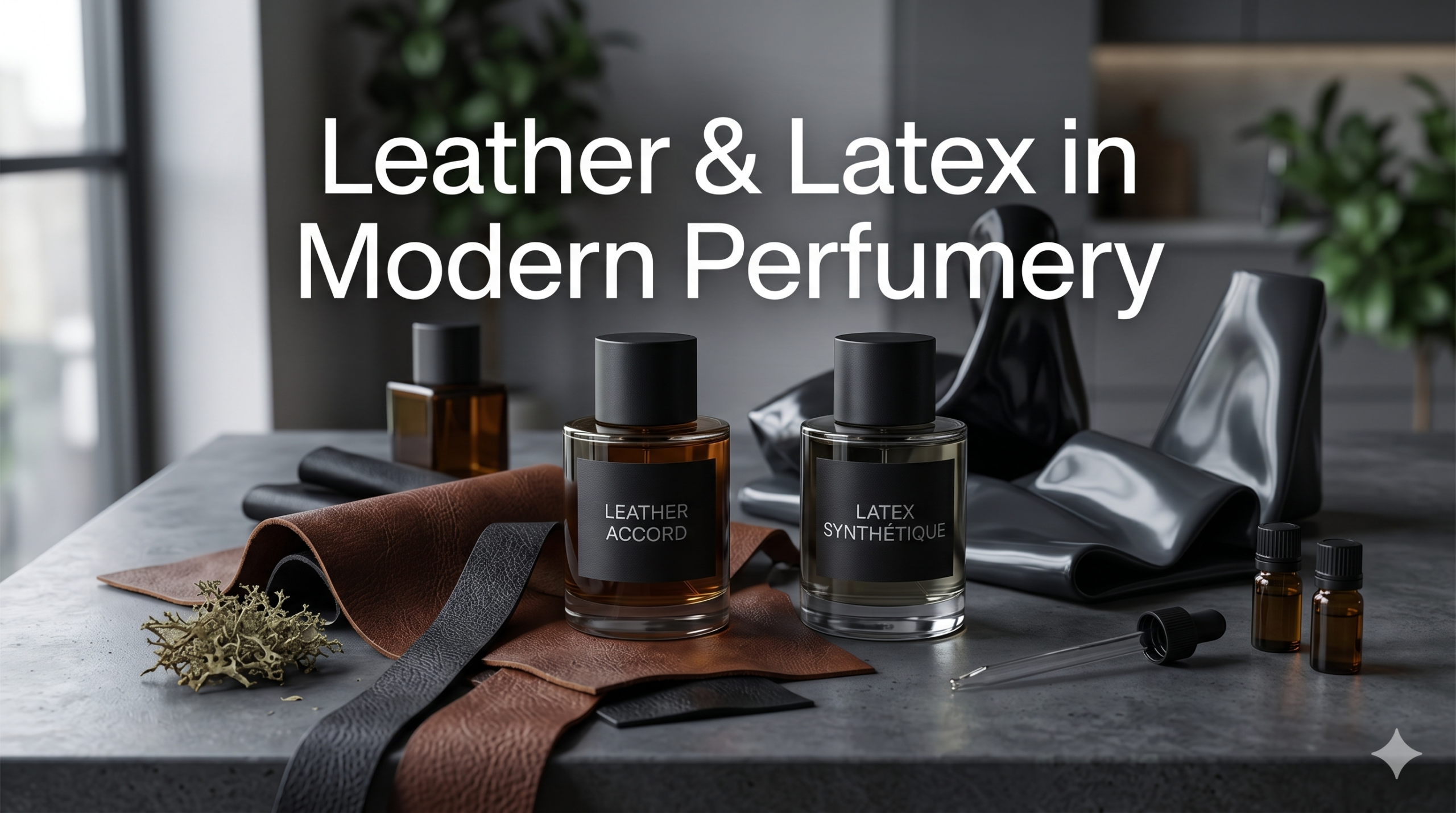
You’ve smelled a thousand florals. You’ve worn your share of fresh aquatics. And one day, something different catches you — dry, raw, animalic, a little dangerous — and you realize perfumery has an entire world you’ve barely touched.
That world is leather fragrance. And its stranger cousin, the latex accord.
These are bold, statement-making fragrances that have anchored perfumery’s most iconic creations for a century — and are now driving one of the most exciting movements in niche and luxury perfumery today. This guide covers everything: the history, the chemistry, how to choose, how to wear, and which specific fragrances you should know about. From a complete newcomer to a seasoned collector — this is the only leather fragrance guide you need.
Why Leather & Latex Notes Are Dominating Modern Perfumery
There’s a cultural shift happening in fragrance. The era of safe, crowd-pleasing scents is giving way to something rawer. Gen Z and millennial fragrance consumers are driving demand for niche fragrances with strong, distinctive personalities — and leather sits at the center of that appetite.
Leather has always been a prestige note. It signals status, craft, durability. In the 1920s it showed up in chypres. By the 1970s it was the backbone of seductive powerhouse fragrances. Today, niche leather fragrances are being bought not despite their intensity but because of it.
The latex accord is newer. Emerging from avantgarde perfumery houses in the early 2000s, it occupies a stranger space — rubbery, slightly powdery, industrial but somehow intimate. It’s the smell of new car interiors, surgical gloves, rain on hot asphalt. Divisive? Absolutely. Unforgettable? Without question.
What’s driving this? A few things: the rise of fragrance communities on TikTok and Reddit, where niche leather fragrances get obsessive attention; luxury brands experimenting with provocative, unconventional marketing; and a broader cultural appetite for fragrances that create a reaction, not just a compliment.
Leather notes in perfume are also uniquely versatile. They read as masculine or feminine depending on what surrounds them. Paired with rose and iris: aristocratic femininity. Paired with tobacco and smoke: classic masculine power. Alone, stripped back: something entirely genderless and confrontational.
The Chemistry Behind Leather & Latex Accords
Here’s something that surprises most people: there is no single “leather” molecule. Leather in perfumery is always a constructed accord — a blend of ingredients that together evoke the smell of cured hide, without ever using actual leather.
How Perfumers Build a Leather Accord
Birch Tar & Cade Oil — smoky, tarry, phenolic compounds that mimic the smell of the curing process. The backbone of classic Russian leather accords.
Isobutyl Quinoline (IBQ) — a synthetic molecule discovered in the early 20th century that is the most “leathery” single compound in perfumery. Dry, slightly animalic, unmistakably leather.
Castoreum — historically from beaver castor sacs, now usually synthetic. Adds a warm, animalic, almost fecal undertone that gives leather its rawness.
Aldehydes — used in smaller quantities to add crispness and lift to leather accords, preventing them from becoming too heavy.
Latex accords are typically built around specific musks and rubber-adjacent synthetics — sometimes with a dash of white florals or powdery notes to add that slightly clinical, rubbery character.
Natural vs. Synthetic Leather in Fragrance
The classic era of leather — Chanel’s Cuir de Russie, Robert Piguet’s Bandit — relied heavily on birch tar, cade, and castoreum. These ingredients are genuinely challenging to wear: smoky, animalic, uncompromising.
Modern leather fragrances often use newer synthetics that are cleaner, more wearable, and longer-lasting. This isn’t compromise — it’s a different artistic direction. Tom Ford’s Tuscan Leather, for example, uses a sophisticated blend that reads as plush and luxurious rather than raw and smoky. Neither approach is superior; they simply produce different characters.
The Essential Leather & Latex Fragrances: Niche & Artisan Picks
These are the fragrances serious collectors discuss. Each one is a genuine study in how leather or latex can anchor a scent.
Best for: Cooler months, evenings
Leather style: Smoky & floral
Best for: Year-round, office to evening
Leather style: Smooth & rich
Best for: Collectors, cold weather
Leather style: Raw & chypre-heavy
Best for: Autumn, casual wear
Leather style: Classic & smoky
Best for: Evening, intimate occasions
Leather style: Animalic musk-leather
Best for: Risk-takers, avant-garde collectors
Leather style: Incense leather
Leather & Latex Fragrances Comparison Table
| Fragrance | Type | Key Notes | Conc. | Gender | Rating |
|---|---|---|---|---|---|
| Cuir de Russie — Chanel | Floral Leather | Russian leather, iris, ylang-ylang | EDP/Parfum | Feminine / Unisex | ★★★★★ |
| Tuscan Leather — Tom Ford | Warm Leather | Leather, raspberry, saffron, suede | EDP | Unisex | ★★★★★ |
| Bandit — Robert Piguet | Chypre Leather | Leather, galbanum, iris, oakmoss | EDP/Parfum | Feminine / Unisex | ★★★★★ |
| Knize Ten — Knize | Classic Leather | Leather, birch tar, vetiver | EDC/EDT | Masculine | ★★★★☆ |
| Musc Ravageur — F. Malle | Animalic Musk | Musks, vanilla, cinnamon, lavender | EDP | Unisex | ★★★★★ |
| Rien — ELDO | Incense Leather | Leather, incense, iris, civet | EDP | Unisex | ★★★★☆ |
| Bel Ami — Hermès | Aromatic Leather | Leather, woods, honey, carnation | EDT | Masculine | ★★★★☆ |
| Doblis — Hermès | Suede Leather | Suede, iris, vetiver, sandalwood | Parfum | Feminine / Unisex | ★★★★★ |
How to Choose a Leather Fragrance: A Practical Guide
Leather fragrances span an enormous range. Knowing where you want to land before you start sampling will save you a lot of money and confusion.
Decide Your Leather Style First
- Smoky & Tarry: You want the rawness of birch tar and cade — old-school, confrontational leather. Try Knize Ten or Bandit.
- Smooth & Plush: You want luxury car leather, warm and enveloping. Tuscan Leather is your benchmark.
- Floral Leather: You want femininity without sweetness — leather as a backbone. Cuir de Russie is the masterclass.
- Animalic & Sensual: You want something that wears close to the skin, alive and intimate. Musc Ravageur and vintage castoreum-heavy fragrances.
- Avant-Garde / Niche: You want something that will make people ask questions. Rien and the output of houses like ELDO or Zoologist.
Consider the Occasion & Season
Bold leather fragrances are almost universally better in cooler temperatures. Heat amplifies projection dramatically — a fragrance that reads as sophisticated in November can become overwhelming in August.
For date night fragrances with leather character, look for compositions that soften the leather with amber, vanilla, or rose. For daytime or office wear, suede-forward or lighter leather compositions work better than heavy tarry ones.
Sampling Before You Buy
This cannot be overstated: always sample leather fragrances before purchasing a full bottle. Leather is one of the most divisive note families in perfumery. What smells extraordinary to one person can be genuinely unwearable to another. Decant services like Surrender to Chance or The Perfumed Court let you test 1–5ml before committing.
Leather Fragrances by Budget
Application Tips for Bold Leather & Statement Fragrances
Getting the Most from Leather Fragrances
- Pulse points, not a cloud: Apply to wrists, inner elbows, neck base. Bold leather fragrances don’t need spraying into the air.
- Skin, not clothes: Leather notes perform best on warm skin. They can stain delicate fabrics and the drydown character is better experienced on skin.
- Less in summer: One or two sprays maximum in warm weather. Heat amplifies projection — what’s subtle indoors becomes a statement outside.
- Give it time: Leather fragrances often smell harsh or overwhelming immediately after application. The real character emerges 20–40 minutes in. Don’t judge a leather fragrance in the first five minutes.
- Moisturised skin holds it longer: Apply an unscented lotion before your fragrance for better longevity, especially with drier vintage leather formulations.
- Don’t rub: Rubbing wrists together breaks down the molecular structure of the top notes faster. Let it dry naturally.
Leather & Latex Scents by Gender
Best Leather Perfumes for Women
The finest leather perfumes for women treat leather as a structural element rather than the whole story. Cuir de Russie by Chanel remains the benchmark — iris and leather in perfect counterpoint, smelling simultaneously like an aristocrat’s wardrobe and a modern woman who doesn’t need anyone’s approval.
Other standouts: Bandit by Robert Piguet (unflinchingly bold, the definitive leather fragrance for women who know exactly who they are), Doblis by Hermès (soft suede and iris, feminine without being sweet), and Rien by Etat Libre d’Orange (incense-driven leather for the true avant-garde enthusiast).
Men’s Leather Cologne Recommendations
Classic men’s leather cologne territory includes Knize Ten — a 1924 composition that still outperforms most modern attempts — alongside Hermès Bel Ami, Tom Ford Tuscan Leather, and the vintage masculinity of Azzaro Pour Homme.
For bold leather fragrances for men with more contemporary character, look at Bvlgari Man in Black (leather-amber hybrid, widely wearable), or for something more niche and challenging, the entire output of Czech & Speake.
Unisex & Gender-Neutral Leather Fragrances
The best leather fragrances have always been inherently unisex, even when marketed otherwise. Tuscan Leather, Musc Ravageur, Cuir de Russie, and most niche leather offerings wear beautifully regardless of gender. The note itself has no gender — your skin chemistry and the composition around it determine how it reads.
2024–2025 Leather & Latex Fragrance Trends
A few movements are worth tracking if you’re building a leather fragrance wardrobe right now:
- Leather + Rose: The combination is everywhere in niche perfumery — Killian’s Dark Lord, various Roja Dove creations. Simultaneously old-fashioned and electric.
- Suede over leather: Softer, more approachable suede accords are dominating new releases aimed at younger audiences. Less confrontational, easier to wear daily.
- Latex as avant-garde: True latex accords remain the domain of experimental niche houses — ELDO, Escentric Molecules, and a handful of indie perfumers. They’re divisive but growing.
- Leather + oud: Middle Eastern perfumery has long fused oud and leather; Western niche houses are increasingly following suit. Rich, complex, long-lasting compositions.
- Dark florals with leather: Gothic-adjacent compositions where leather underpins heavy florals like tuberose, black rose, or dark iris. One of the most exciting creative spaces right now.
Gateway Fragrances: Start Here Before Going Niche
Not ready to jump straight to Knize Ten or Bandit? These widely-available fragrances share some of the boldness and character of true leather perfumery — great starting points if you’re new to statement scents. Available via Amazon for easy access.
Frequently Asked Questions: Leather Fragrances
What does a leather fragrance smell like?
It depends on the composition, but most leather fragrances share a dry, slightly smoky, animalic quality that recalls cured animal hide — sometimes raw and confrontational, sometimes smooth and plush like a new luxury car interior. Many are layered with florals, spices, or musks that soften or direct the leather character.
Are leather fragrances masculine or feminine?
Leather is one of the most genuinely unisex note families in perfumery. Historically it appeared in both masculine and feminine fragrances. The composition surrounding the leather accord determines how it reads — floral leather leans feminine, tobacco-leather leans masculine, but both wear beautifully on any skin.
What is a latex fragrance?
A latex accord in perfumery mimics the smell of natural or synthetic rubber — slightly powdery, rubbery, industrial. It’s often used in small amounts as part of a larger composition rather than as the star note. Houses like Etat Libre d’Orange have explored it most boldly. It’s a genuinely niche, avant-garde direction in modern perfumery.
How long do leather fragrances last?
Most leather EDPs and parfums last 8–12 hours on skin, with many leaving a leather sillage on clothing for significantly longer. Lighter leather EDTs tend toward 4–6 hours. The note itself has good natural longevity — the supporting notes around it determine overall staying power.
Where to Go Next
Leather and latex fragrances reward patience and curiosity. The best approach is systematic sampling — start with one or two of the gateway fragrances above to understand bold, statement-making scents, then move toward Hermès Bel Ami or Tom Ford Tuscan Leather as your first genuine leather fragrance, before exploring the more challenging territory of Bandit or Cuir de Russie.
For ongoing fragrance exploration — niche reviews, note breakdowns, and trend analysis — DryDown Dairies covers the full spectrum of modern perfumery with the same honesty and depth you’ve found here.
The leather world is patient. It’s been here since 1924, and it’ll be here when you’re ready. Start with one sample. See where it takes you.